Pakistan · Political Violence · Benazir Bhutto
The Unsolved Mystery of the Assassination of Benazir Bhutto
Her return, the threats, the bombs, the missing evidence, the rival accusations and the long history of a state in which power has too often travelled beside fear.

There are murders which are solved by finding the man who pulled the trigger, and there are murders which expose the whole condition of a country. Benazir Bhutto's assassination belongs to the latter order. Nearly two decades have passed since she was struck down outside Liaquat Bagh in Rawalpindi on 27 December 2007, yet Pakistan still possesses no final judicial account of who conceived the killing, who financed it, who directed it, who failed to prevent it, and who profited from the confusion that followed. The appeals dragged through the courts, alleged conspirators were acquitted or disappeared, senior police officers were convicted and later released on bail pending appeal, Pervez Musharraf died without standing trial, and men whom investigators once described as planners or intermediaries vanished into the violent history of Pakistan's tribal wars. The killing remains what it became within hours of the blast, a national wound surrounded by competing explanations.
Benazir Bhutto had always belonged to a dynasty in which politics and death were unnaturally close companions. Her father, Zulfikar Ali Bhutto, was overthrown by General Zia-ul-Haq and hanged in 1979 after a trial that remained controversial for decades. Her brothers Shahnawaz and Murtaza died violently. The family name carried the prestige of popular politics and the fatalism of tragedy. Benazir entered public life beneath that shadow and twice became prime minister, first in 1988 and again in 1993, making history as the first woman to lead a Muslim-majority country. Yet neither premiership ended normally. Both governments were dismissed amid allegations of corruption, abuse of power and institutional conflict. By the end of the 1990s she was abroad, facing legal cases and political exclusion, while Pakistan returned once again to military rule under General Pervez Musharraf.
By 2007 the balance of power was changing. Musharraf's authority had weakened badly. The dismissal of Chief Justice Iftikhar Muhammad Chaudhry had ignited a lawyers' movement, militant violence was rising, and Washington and London were encouraging a political accommodation between Musharraf and Bhutto that might produce a more civilian face for Pakistan's government. The arrangement was never clean. Bhutto needed the legal obstacles to her return reduced. Musharraf needed legitimacy. The National Reconciliation Ordinance, promulgated in October 2007, granted amnesty in certain corruption cases and became one of the most controversial political bargains in the country's history.
Bhutto nevertheless decided that exile could no longer be endured. She announced that she would return on 18 October 2007. The United Nations inquiry later recorded that Musharraf and people around him had wanted her to delay her return until after the elections, officially because of grave security threats. Bhutto believed that security warnings might also be used to keep her away from the campaign and weaken her prospects in the coming election. She knew there were dangers. She returned anyway.

The scenes in Karachi were enormous. Hundreds of thousands crowded the roads to welcome her home. Bhutto stood above the procession in green and white, smiling and waving while the convoy crawled along Sharea-e-Faisal. For several hours the homecoming possessed the old theatrical majesty of South Asian politics, where a returning leader is not merely greeted but received as though by a people recovering a lost inheritance.
Then the bombs came. Two explosions tore through the procession at Karsaz. Roughly two hundred people were killed and hundreds were wounded. Bhutto survived. The attack itself was never satisfactorily solved. She blamed extremist groups but also expressed suspicion that hostile elements within the old state apparatus might have facilitated the threat against her. The government pointed towards militants. Pakistan began at once to divide into camps of belief.
That first attack should have transformed every calculation concerning her security. Instead, two months later, Benazir Bhutto was dead.
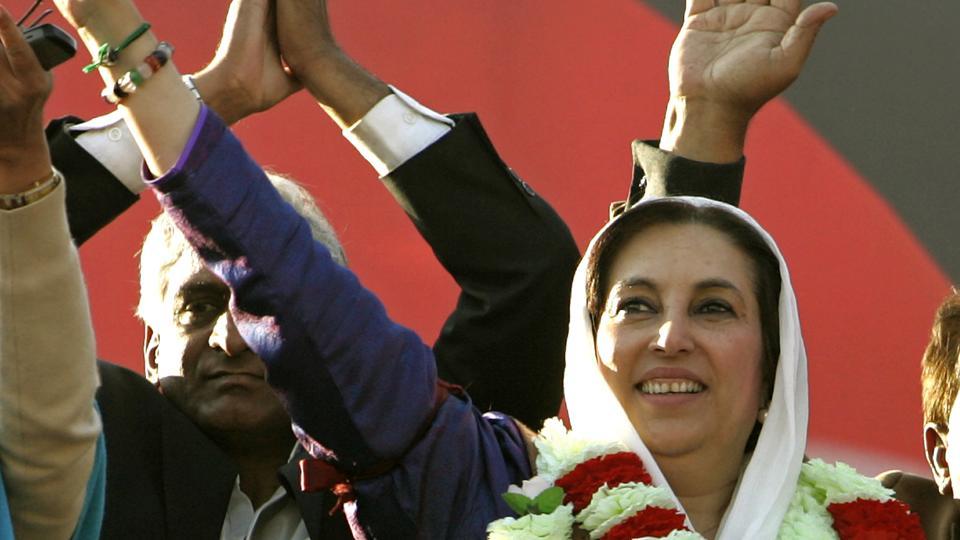
On 27 December 2007 she addressed an election rally at Liaquat Bagh in Rawalpindi, a place already heavy with Pakistani history because the country's first prime minister, Liaquat Ali Khan, had been assassinated there in 1951. Bhutto finished her speech, entered her vehicle and then rose through the sunroof to acknowledge supporters outside. A gunman approached. Shots were fired. Almost immediately there was an explosion. Bhutto collapsed inside the vehicle and was taken to hospital, where she was pronounced dead.

From that moment the handling of the case began to manufacture suspicion almost as rapidly as investigators could collect evidence. The government initially gave conflicting explanations for the cause of death. Officials suggested that she had not been killed by bullets or shrapnel but by striking her head against the lever of the vehicle's sunroof. The claim provoked outrage. No post-mortem examination was conducted, leaving one of the most elementary forensic questions forever burdened by uncertainty.
The crime scene that disappeared
Within hours of the assassination, police washed down the scene with water hoses. Whatever the stated reason, the effect was disastrous. Fragments, residue, blood patterns and other physical evidence that might have assisted a reconstruction of the attack were lost or contaminated. The destruction of that scene became one of the most enduring reasons the assassination generated suspicion far beyond the ordinary uncertainties of a terrorism investigation.
The United Nations Commission later regarded the washing of the scene as extraordinary and found the investigation deeply deficient. Its conclusion was not that the assassination had been ordered by the Pakistani state. It was that the authorities had failed profoundly both in protecting Bhutto and in investigating her murder. That distinction remains essential. Institutional failure is established far more firmly than any theory identifying a hidden state mastermind.
The government's early case turned towards Baitullah Mehsud, the powerful militant commander associated with what became the Tehreek-i-Taliban Pakistan. Officials released what they said was an intercepted telephone conversation in which Mehsud appeared to congratulate another man after the killing. Mehsud denied responsibility. Investigators later built a case around alleged facilitators and young suicide bombers linked to extremist networks in Pakistan's northwest. Yet the prosecution could not establish the case in court against five men accused of involvement. They were acquitted in 2017 for lack of sufficient evidence.
This is where the mystery becomes larger than the name of a militant commander. A murder conspiracy is not necessarily identical to the young man who carries the explosives. The fact that Pakistan may have identified people involved in preparing or executing the attack never answered the more dangerous question of who ultimately ordered it.

The UN Commission examined more than one hypothesis. It acknowledged the grave threat to Bhutto from militant organisations, including Al-Qaeda and Taliban-linked networks. At the same time, it recorded her own fear of elements within what Pakistanis commonly call the Establishment, a term embracing powerful military and intelligence interests beyond ordinary civilian accountability. The Commission did not conclude that Musharraf or the military had ordered her assassination. It did find that government officials had failed to provide security proportionate to the known threat and that investigators had not pursued all leads vigorously.

Bhutto herself had contributed to the atmosphere of suspicion before her death. She had written to Musharraf naming people she feared might pose a danger to her. She complained publicly that adequate security equipment and arrangements had not been provided. After the Karsaz attack, she became more explicit about the possibility that militant violence could overlap with individuals enjoying protection or sympathy within the state. These fears were political allegations, not judicial findings, but after her assassination they became central to the public imagination.
Musharraf always rejected allegations that he was responsible for her death. His government's position was that extremist militants had killed her. Years later Pakistani prosecutors named Musharraf as an accused in broader criminal proceedings, alleging failures connected with her security. In 2017 an anti-terrorism court declared him a proclaimed offender because he was outside Pakistan and did not appear before the court. He died in Dubai in 2023, leaving the legal questions concerning his role unresolved.
The most concrete convictions were not for planning the assassination. They concerned two senior police officers, Saud Aziz and Khurram Shehzad, whom an anti-terrorism court sentenced in 2017 for criminal negligence and destruction or mishandling of evidence. Their sentences were later suspended while appeals remained pending. The five militant suspects tried with them were acquitted. The judicial proceedings then entered the familiar machinery of appeals and delay.
That history is itself an indictment. A former prime minister is assassinated in full public view. A crime scene is washed. No post-mortem is performed. The alleged mastermind is never tried. The alleged facilitators are acquitted. Police officers are convicted and then remain in appellate limbo. Musharraf dies abroad. The political party led by Bhutto subsequently governs Pakistan, yet even under that government the conspiracy is never conclusively unravelled.
It is therefore understandable that Pakistanis continue to ask the question the courts have not answered. Who benefited?
The militants had obvious motives. Bhutto had spoken against extremism. She represented the prospect of a civilian government aligned with Western powers and willing to confront jihadist networks. Her return threatened forces that regarded her social liberalism, her gender and her political partnerships as intolerable.
Musharraf's political system also faced danger from her return. A strong Bhutto-led PPP could reshape the post-election balance and diminish military influence. But political rivalry is not proof of assassination, and suspicion cannot be allowed to masquerade as evidence. Her domestic opponents within civilian politics also stood to gain from her disappearance in the crude arithmetic of power, but again there is no judicial basis for accusing them of murder.
Then there are the shadowier possibilities familiar to Pakistani history, where militant organisations, intelligence connections, sectarian networks, criminal intermediaries and political patrons have sometimes occupied overlapping worlds. These possibilities are precisely why the destruction of evidence mattered so much. Once the forensic trail is damaged, every theory becomes harder to prove and every rumour harder to kill.

The assassination changed Pakistan immediately. The country convulsed. Rioting followed. Elections were postponed. The Pakistan Peoples Party entered the campaign transformed by grief. Benazir's son Bilawal Bhutto Zardari was named chairman, while Asif Ali Zardari became the effective political authority in the party. The PPP went on to form the federal government after the 2008 election.
There is a terrible symmetry in all this. Zulfikar Ali Bhutto was removed by a general and hanged. Benazir Bhutto was killed after returning from exile to challenge another general's political order. Murtaza Bhutto had already been killed in Karachi during his sister's premiership. Pakistan's history does not permit the Bhutto family to be discussed merely as a political dynasty. It has become an archive of the country's quarrel with power itself.
Yet Benazir should not be converted into a flawless martyr merely because she died violently. Her governments were controversial. Corruption allegations followed her and her husband for years. Her style of party leadership was dynastic. Her negotiations with Musharraf were criticised as opportunistic. Many Pakistanis who mourned her assassination had opposed her politics. Democracy does not require a murdered politician to have been innocent of every political failing. It requires that political rivalry end at the ballot box.
Pakistan has repeatedly failed that elementary test. Its political history has been polluted by coups, executions, prison cells, exiles, disqualifications, assassinations and the constant suspicion that elections are only one battlefield among several. Generals have removed prime ministers. Prime ministers have imprisoned opponents. Parties have treated institutions as instruments. Militants have assassinated politicians. Courts have been pulled into political struggles. The state has often asked citizens to believe official explanations that later collapsed under scrutiny.
The result is a republic in which conspiracy theories flourish because official history has too often proved unreliable. Benazir Bhutto's assassination remains powerful precisely for that reason. Had the scene been preserved, had a post-mortem been conducted, had every security failure been explained, had the chain of command behind the attackers been identified, had suspects been tried successfully and had the masterminds been exposed, the country might have possessed an answer even if that answer were painful. Instead it inherited doubt.
The United Nations Commission delivered perhaps the most devastating judgment of all. The assassination, it concluded, could have been prevented had adequate security measures been taken. Its inquiry into what followed found failures that were not merely technical but institutional. That is why the question has survived longer than many of the men who were once accused.
Who killed Benazir Bhutto? A suicide attacker helped kill her. Extremist networks had motive. Investigators believed militant planners were involved. Police negligence was established by a trial court. The state failed to protect her adequately. The investigation was compromised. Political suspicions reached as high as Musharraf's government and the security establishment, but no court proved that either ordered the assassination. The masterminds were never conclusively brought before the law.
Nearly two decades later, that is the honest answer. Pakistan knows much about the murder of Benazir Bhutto. It still does not know enough to close the case.
And perhaps the most unsettling fact is that the mystery no longer belongs only to the dead woman at Liaquat Bagh. It belongs to Pakistan itself, a country still compelled to ask whether power can change hands without vengeance, whether opposition can exist without hatred, and whether truth can survive when evidence is washed from the road before the blood has dried.