THE CONTINENTAL NEWS · SPORT & HISTORY
The Tale of the Greatest Boxer
“I am the greatest,” Muhammad Ali told the world. Joe Frazier made him answer for it. George Foreman gave him a last, improbable chance to prove it. And the country that took away his championship eventually stood to watch him light the Olympic flame.
George Foreman was falling, and Muhammad Ali had time to hit him once more. Watch the film. The champion is already turning as he goes down. Ali follows him with his eyes, his right glove ready. The blow never comes. There had been enough of them. In the eighth round in Kinshasa, after a long night of taking punches that looked capable of breaking a man in two, Ali had put the most formidable heavyweight alive on the floor. He was thirty-two years old. The better part of the boxing trade had come to Africa expecting to see him beaten. AP Photos
Ali had called himself the greatest so often that the words could sound like part of his entrance music. They had been a young man’s audacity, then a champion’s advertising, then a joke his enemies were impatient to see answered. By the time Foreman fell, the claim had survived a government prosecution, a forced absence from boxing and a left hook from Joe Frazier that put Ali on his back in Madison Square Garden. He knew by then what the boast would cost him. That is what makes it worth hearing.
The boy who wanted his bicycle back
Cassius Marcellus Clay Jr. was born in Louisville, Kentucky, in 1942. His father painted signs and murals. His mother, Odessa, did domestic work. The family lived by its labour in a segregated city. Some accounts make his childhood sound like destitution, though biographer Jonathan Eig describes his upbringing as middle-class. What the household earned could buy a boy a bicycle. It could buy him very little protection from the indignities waiting for him outside his own street. abc17news.com
At twelve, Clay reported his bicycle stolen to a police officer named Joe Martin and announced that he meant to thrash the thief. Martin trained young boxers. He suggested the boy learn how to fight first. There is something pleasingly ordinary about the exchange. The child was angry over a bicycle. The policeman knew where there was a gym. Neither man, if we may grant the boy the dignity of his fury, had any particular reason to imagine that their conversation would be repeated after both of them were dead. alicenter.org
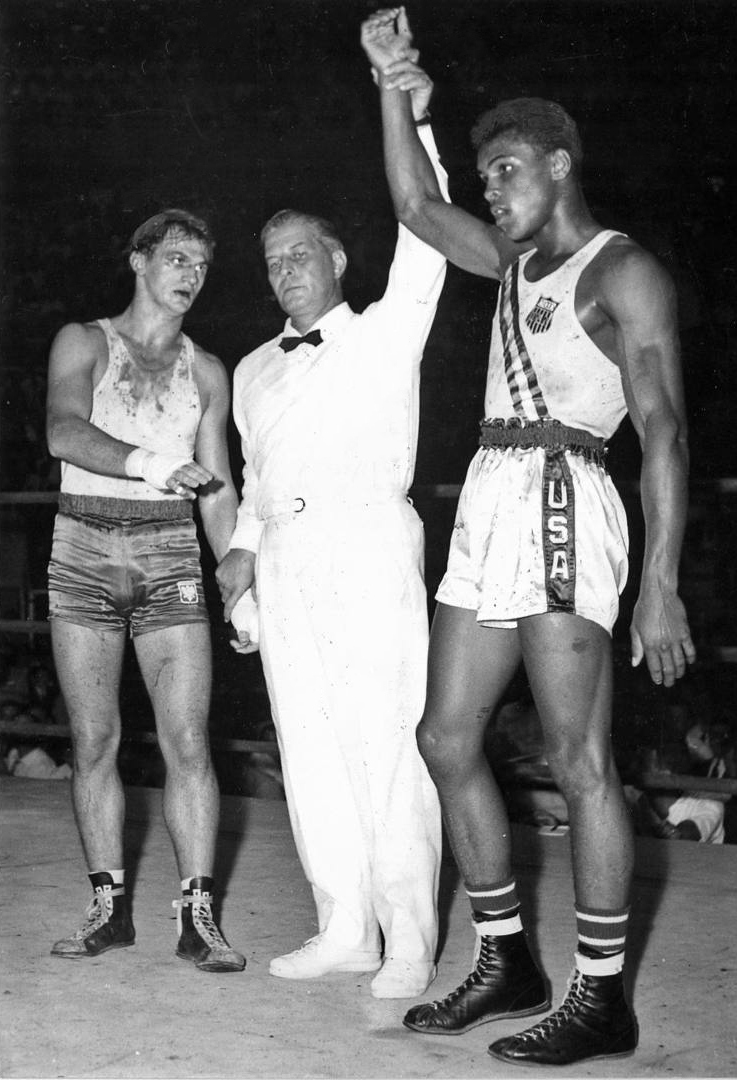
Six years later, at the 1960 Rome Olympics, Clay defeated Poland’s Zbigniew Pietrzykowski for the light-heavyweight gold medal. The Pole was an experienced international boxer. The American was eighteen, already astonishingly quick, and willing to take a good look at what an older man could do before deciding how to beat him. Clay came home with a prize that made him a representative of the United States. Louisville had its own ideas about what that distinction entitled him to. www.lpm.org

The medal and the river
In Ali’s telling, he was refused service at a Louisville restaurant, and the Olympic medal eventually went into the Ohio River. His autobiography gives a more elaborate version involving a confrontation after the refusal. Other accounts say he lost the medal. The Muhammad Ali Center treats its fate as unknown. An Olympic replacement was presented to him in Atlanta in 1996. As for the whereabouts of the original, the honest answer is that nobody has settled it. alicenter.org
The story has the shape of a parable because the country had furnished the contradiction. A young Black man could be sent abroad to win honour for America and return to a city where the colour of his skin might decide whether he could sit down for lunch. There was enough truth in that arrangement to explain why the tale travelled. The image of a boy standing over dark water, deciding what his country’s gold was worth to him, has outlasted most of the certainties offered by the men who expected him to be grateful.
The night he made Sonny Liston sit down
Heavyweights were supposed to plant their feet and make an argument with their shoulders. Clay would give a man a glimpse of his chin and move it before the punch arrived. He carried his hands low, drew back from blows and hit from distances at which other men were still getting ready. A trainer could compile a convincing list of the things he did wrong. The opponent then had to reach him. His early speed made possible a style that would exact a price when his legs grew older.
Sonny Liston was the first champion obliged to reckon with the full nuisance of him. In Miami Beach in February 1964, Clay made the fight a public trial of Liston’s patience before either man put on gloves. Then he made the champion turn and reach. There was danger enough in it. Clay’s eyes began to burn in the middle rounds, and he had to get through a stretch in which he could scarcely see. He recovered. Liston stayed on his stool when the seventh round was due to begin. Clay was twenty-two and the heavyweight champion of the world. The loudest young man in the building had also been the most composed when it mattered. usopm.org
Soon afterwards he publicly embraced the Nation of Islam, used Cassius X briefly and took the name Muhammad Ali. Malcolm X had been his friend and mentor. When Malcolm split from the Nation, Ali stayed loyal to Elijah Muhammad and turned away from him. Malcolm was murdered in 1965. Decades later Ali wrote that abandoning him was among his deepest regrets. His religious life continued to change, and he later embraced Sunni Islam. For all his confidence in public, there were choices he could reconsider only after the person most entitled to hear him was gone. www.archives.gov
The years nobody could give him back
In April 1967 Ali refused induction into the United States military. He opposed the Vietnam War and sought recognition as a conscientious objector on religious grounds. He was convicted, fined $10,000 and sentenced to five years in prison. He remained free while appealing, but lost his championship and spent more than three years out of professional boxing. He was twenty-five. At that age a great fighter expects the next three years to settle his place in the sport. Ali spent much of his time speaking on campuses and waiting for his case to make its way through the courts. www.archives.gov
The Supreme Court overturned his conviction in June 1971. The appeals board that rejected his claim had given no reason for its decision, and the justices could not determine whether it had relied on grounds the government no longer defended. By then Ali had returned to boxing. Four months before the Court’s decision, he had gone to Madison Square Garden to try to take the championship from Joe Frazier. Anyone who wished to know what those missing years had taken from him could watch Frazier make the inquiry in person. www.law.cornell.edu
Joe Frazier had his own idea of greatness
Their first fight, on 8 March 1971, brought two unbeaten heavyweights into the same ring. Ali was the deposed champion. Frazier held the title and had done every piece of work required to get it. He was a short heavyweight who could make a taller man spend an entire evening trying to find room for his elbows. He moved his head as he came forward, hooked to the body and kept coming when a clean punch gave him good reason to think again. Ali hit him with shots that would have made a less determined man reconsider his trade. Frazier made him throw them under pressure for fifteen rounds. alicenter.org
In the fifteenth, Frazier’s left hook caught Ali flush. Ali went down hard, his legs out from under him. He rose. There was character in the rising, and Frazier deserved every point he earned in putting him there. The decision was unanimous. In a profession that sells a great many arguments, this one ended with a plain answer. Joe Frazier had beaten Muhammad Ali. alicenter.org


Ali took their second fight in January 1974, when neither man held the title. The third, the following year in Manila, was the most punishing of the three. In the heat, Ali hit Frazier often enough to leave him struggling to see. Frazier made Ali pay for every spell in which he could get close. After the fourteenth round, Frazier’s trainer, Eddie Futch, stopped him going out again. A trainer who stops a fight has to live with the fighter’s conviction that he could have won it. Futch had seen enough to accept that burden. alicenter.org
Ali’s behaviour outside the ring deserves the same scrutiny as his conduct inside it. He called Frazier an “Uncle Tom” and a “gorilla”. Frazier, who had come out of poverty in South Carolina, found himself portrayed as a servant of white interests by a man with a louder voice and a better audience. His children were taunted at school. Ali’s wit could help expose a national hypocrisy. Here it helped him humiliate a fellow Black fighter. Frazier’s grievance had a long life because the injury was real. He also gave Ali the hardest proof of his greatness, and had a right to be remembered for more than the role Ali had written for him. www.inquirer.com
The Rumble in the Jungle
Between the second and third fights with Frazier came George Foreman. He had knocked Frazier down six times in two rounds to take the title. He was younger than Ali, unbeaten, and strong enough to make men hurry away from punches they had only seen him begin to throw. The bout went to Kinshasa, then the capital of Zaire, under Mobutu Sese Seko. The regime gained a spectacle it could show the world. Many of the people who turned out to see Ali had reasons of their own for taking him to heart. Their chant called on him to finish Foreman. From ringside, anyone with a concern for Ali’s health might have settled for seeing him get through the night. AP Photos
On 30 October 1974, Ali began by landing right hands that Foreman had little reason to expect so early. Then he spent long stretches against the ropes. The strategy acquired a jaunty name, the rope-a-dope, as though taking punches from Foreman were a confidence trick one could safely teach an apprentice. Ali covered himself, leaned away, tied Foreman up and answered when he saw an opening. Plenty of blows still got through. The distinction between taking some force out of a punch and escaping it altogether is one the body understands better than the spectator. Ali trusted himself to endure what came through and to recognise the moment when Foreman could no longer keep up the work. AP Photos
In the eighth he found that moment. A quick combination finished with a right hand, and Foreman went down. The former champion who had once depended on his legs to keep him out of danger had found a way to win with danger in his lap. Kinshasa settled the larger boxing question about Ali. The young man who beat Liston could outmove a great puncher. The older man who beat Foreman could read one, tire him and bring him down. The difference between those two performances was a career’s worth of learning. AP Photos


The man who had to come home
Ali’s private life moved at a different speed from his public one, though the two were forever running into each other. He married Sonji Roi, then Khalilah Ali, then Veronica Porché. All three marriages ended in divorce. In 1986 he married Yolanda “Lonnie” Williams, who remained his wife until his death. His daughter Laila took up boxing and became a champion in her own right. It is easy to make a list of marriages and children and call it a private life. Harder to imagine is a household in which a man belongs so thoroughly to the public that strangers feel entitled to his time wherever he goes. Later, when illness made an appearance more demanding, people still wanted to see him. Lonnie lived with the man after the appearance was over. abc17news.com
He lost the title to Leon Spinks in 1978 and won it back that September, becoming the first man to win the world heavyweight championship three times. The sport would have had a fine last photograph if he had stopped there. Instead there was Larry Holmes in 1980, hitting a man who could scarcely answer until Ali’s corner ended it. There was Trevor Berbick in 1981, and a final defeat. Ali retired with 56 wins and five losses. He was diagnosed with Parkinson’s disease in 1984. The late fights are hard to watch. The audience knew what his body had once been able to do, and that knowledge could keep people hoping for another round long after the evidence for hope had gone. alicenter.org
At the Atlanta Olympics in 1996, the hand that had sent Foreman to the floor trembled as Ali held the torch. The stadium waited while he lit the cauldron. There was no need for a commentator to explain the interval. Anyone who had watched him as a young man knew how much of his authority had come from doing something before others could see it coming. Now he had to do something slowly before an audience that could see every movement. He finished the task. Later in the Games came the replacement medal. The first one, wherever it lay, had done all the work that could be asked of a piece of gold. alicenter.org
Ali died on 3 June 2016, aged seventy-four. There will always be an argument about who was the greatest boxer, and Frazier would have been entitled to an opinion. Ali himself had supplied a good deal of the evidence on both sides. He could be vain and mean. He could give away years of his professional life for a conviction and refuse to pretend it had cost him nothing. He could go to Africa with the world expecting his defeat, work out how to beat George Foreman and have the presence of mind, in the instant that decided it, to hold back the last punch. After all the noise he made, that is the moment I would show somebody who wanted to understand him. abc17news.com