A Wedding Where History Arrived Before the Guests
NEW DELHI, 5 NOVEMBER 2026 — There are weddings, there are grand weddings, and then there are those uncommon assemblies of Indian society at which the guest list appears to have been compiled by a historian with an extravagant imagination. Such was the gathering in New Delhi this week when Rajkumar R. K. Martand Singh, a descendant of Jammu and Kashmir's former ruling Dogra dynasty, married Rhea Badal, daughter of one of Punjab's best-known political families.
The occasion had everything that lends an Indian aristocratic wedding its peculiar splendour. There were ancestral names whose associations reach back to the princely states, families joined by marriages extending across generations, politicians who have spent their lives on opposing sides of Parliament, and elaborate ceremonial dress through which an old aristocracy continues to proclaim its identity.
And then there was the Prime Minister of India.
Narendra Modi attended the reception on Tuesday, 3 November, at the Lutyens' Delhi residence of Jai Inder Kaur, daughter of former Punjab Chief Minister Captain Amarinder Singh. He greeted members of the families and blessed Martand Singh and Rhea Badal. The celebrations also included an Anand Karaj ceremony on Wednesday.
The symbolism was difficult to overlook.
Here was the elected head of the world's most populous democracy, standing among descendants of men and women whose ancestors had once exercised hereditary authority over substantial territories of the Indian subcontinent.
Their kingdoms had disappeared into the republic decades earlier. Their titles no longer carried constitutional privilege. Yet the families remained, their genealogies interwoven with the political establishment that succeeded the princes.
The Republic had not merely made peace with the old royal houses. It had invited them into the democratic drawing room, where former rulers and elected representatives had learned to recognise one another as members of the same influential social world.
There was additional historical poignancy in the presence of Dr Karan Singh, the groom's grandfather.
At ninety-five, Dr Singh stands among the last surviving public figures whose lives personally connect the princely India of 1947 with the constitutional republic of the twenty-first century.
His father, Maharaja Hari Singh, signed Jammu and Kashmir's Instrument of Accession to India during the upheaval of Partition. His grandson's wedding, attended by the Prime Minister in 2026, offered a remarkable illustration of how far the country's political institutions have travelled while the personal histories of its most prominent families remain intimately connected.
But before returning to the glittering celebrations in Delhi, one must travel much farther back.
The story begins in the nineteenth century, in a world of Sikh power, British imperial ambition, mountainous kingdoms and the rise of a Dogra soldier who would become a maharaja.
Gulab Singh and the Making of the Dogra Kingdom

The story of the Dogra dynasty begins with Maharaja Gulab Singh, born in 1792, whose ascent occurred during the formidable expansion of Sikh power under Maharaja Ranjit Singh.
Gulab Singh was a soldier and political operator of considerable ability. The consolidation of his authority over Jammu became part of a larger imperial drama in which the Sikh kingdom, British East India Company and various Himalayan principalities competed for territory and advantage.
The decisive moment arrived in 1846.
Following the First Anglo-Sikh War, the British imposed a settlement upon the defeated Lahore kingdom. Under the Treaty of Amritsar of 16 March 1846, Gulab Singh obtained sovereignty over Kashmir and extensive adjoining territories in exchange for a payment of seventy-five lakh Nanakshahi rupees and acceptance of the treaty's conditions.
The treaty remains among the most controversial documents in the history of Kashmir.
For the British, it was an imperial settlement. For Gulab Singh, it represented the foundation of an extraordinary territorial achievement. For many Kashmiris, it has come to symbolise the sale of a land and its inhabitants through an agreement in which the people themselves possessed no political voice.
These contrasting interpretations cannot be removed from history merely because the descendants of those who signed the treaty later became distinguished figures in independent India.
The Dogra state was an extraordinary construction. It brought together Jammu, the Kashmir Valley, Ladakh and other territories whose populations spoke different languages, followed different religious traditions and possessed histories that could not be reduced to a single royal genealogy.
Its geographical reach was magnificent. Its political contradictions were formidable.
The dynasty survived for roughly a century under British paramountcy. Gulab Singh was succeeded by Ranbir Singh, followed by Pratap Singh and then Hari Singh, the ruler whose reign would witness the collapse of British India and the birth of two independent dominions.
The palaces, court rituals and ceremonial portraits of the Dogra household preserved the outward forms of monarchy. Beyond the palace walls, however, the modern world was preparing to make hereditary sovereignty increasingly difficult to sustain.
By 1947, the question facing Maharaja Hari Singh was no longer how to enlarge a kingdom. It was whether the kingdom could survive at all.
Maharaja Hari Singh and the Year That Changed Everything

Maharaja Hari Singh, born in 1895, succeeded to the throne in 1925. He inherited not merely a royal establishment but a vast and difficult state whose political circumstances were becoming increasingly complicated.
His reign witnessed administrative reforms, demands for popular representation, political mobilisation and growing tensions between the monarchy and emerging nationalist movements.
Hari Singh was a ruler with a strong consciousness of his royal position. Yet he governed during a period in which the very idea of monarchy was being challenged across the subcontinent.
When Britain announced its withdrawal from India, the rulers of the princely states confronted decisions whose consequences would outlive their dynasties.
The Indian Independence Act brought British paramountcy to an end. The princely rulers were expected to determine their future relationship with India or Pakistan, although the political, geographical and popular pressures upon them varied considerably.
Hari Singh initially sought to avoid an immediate commitment to either dominion. His hesitation has been examined and disputed for generations.
For a ruler presiding over a Muslim-majority state with a Hindu dynasty, located between two newly created countries and possessing exceptional strategic importance, the choice was never straightforward.
Yet time, geography and the violence of Partition were steadily removing the luxury of indecision.
In October 1947, armed tribal forces entered Kashmir from the direction of Pakistan. Their advance created an emergency that threatened the Maharaja's authority and the security of the Valley.
Hari Singh sought military assistance from India.
The Instrument of Accession bears the date 26 October 1947 and was accepted by Governor-General Lord Mountbatten the following day. India subsequently airlifted troops into Srinagar, beginning the first Indo-Pakistani war over Kashmir.
The precise chronology of some events surrounding accession has been debated by historians, but the constitutional and military consequences were unmistakable.
The princely state had entered a new historical age.
Partition had already torn apart Punjab and Bengal. Families had been displaced, communities destroyed and the political map of South Asia transformed through extraordinary violence.
Kashmir now became another theatre in that immense upheaval.
The conflict produced a divided territory, competing national claims and a dispute that would endure through subsequent wars, diplomatic initiatives and generations of suffering.
The royal house was no longer master of its political destiny.
And the Maharaja's young son, Karan Singh, was about to enter public life under circumstances no princely education could have adequately prepared him to confront.
Karan Singh, the Prince Who Became a Servant of the Republic

Few Indians of his generation have experienced a transformation of political circumstances as extraordinary as Dr Karan Singh.
Born in 1931, the only son of Maharaja Hari Singh and Maharani Tara Devi, he was raised in the elaborate surroundings of a royal household.
Yet the India in which he came of age bore little resemblance to the India into which he had been born.
In 1949, at eighteen, he became Regent of Jammu and Kashmir as his father withdrew from the state's political administration. He subsequently served as Sadr-i-Riyasat and then Governor.
In 1967, he entered Indira Gandhi's Union Cabinet, beginning another chapter in a career that would encompass national politics, international affairs, scholarship and public service.
Consider the extraordinary sequence.
A young prince who might once have expected to inherit the powers of an hereditary monarch found himself participating in the democratic and constitutional government that had replaced the old order.
The family had lost its ruling authority. Karan Singh would acquire an influence of an entirely different character.
He became a minister, parliamentarian, writer and public intellectual whose interests extended well beyond the customary occupations of former royalty.
His engagement with religion, philosophy, literature and Indian civilisation gave him a distinctive position among public figures.
His life has carried an enduring sense of historical transition. He belongs to a generation that witnessed the passing of one political civilisation and the arrival of another, while retaining intimate knowledge of both.
There is something genuinely remarkable in seeing him at his grandson's wedding, with an Indian Prime Minister attending the celebrations.
The grandfather had lived through the twilight of a princely state. The grandson was marrying in a republic whose political leadership had come to honour the family through social association rather than hereditary obligation.
The Scindias and the Bridegroom's Distinguished Parentage
Martand Singh's father, Vikramaditya Singh, is Dr Karan Singh's elder son. His mother, Chitrangada Raje, belongs to the distinguished Scindia family of Gwalior.
Chitrangada is the daughter of the late Madhavrao Scindia and sister of Union Minister Jyotiraditya Scindia.
Her marriage to Vikramaditya Singh in 1987 established an important familial connection between the former ruling houses of Jammu and Gwalior.
The Gwalior connection brings another remarkable political inheritance into Martand Singh's ancestry.
The Scindias emerged as a major power within the Maratha confederacy. Their later history passed through British paramountcy, princely government and the transition to independent India.
Like the Dogras, the family adapted to the republican order.
Rajmata Vijayaraje Scindia became one of the prominent personalities of Indian opposition politics. Her son, Madhavrao Scindia, established a substantial parliamentary career, serving as a minister in Congress-led governments.
Her grandson, Jyotiraditya Scindia, eventually moved from Congress to the BJP.
These political differences did not dissolve the family.
The Scindias offer an instructive example of an aristocratic household finding its place within modern electoral politics while members adopted markedly different political loyalties.
A wedding involving a descendant of both the Dogra and Scindia families therefore carries more than the glamour of ancestral titles.
It brings together two dynastic experiences of power, loss, political adaptation and continued public prominence.
The sword has given way to the ballot, the palace estate to the heritage enterprise, and the hereditary court to an audience of elected politicians.
The names, however, have survived every transformation.
The Badals, Punjab and the Politics of a Powerful Family

The bride's family possesses a different history, though hardly a less significant political one.
Rhea Badal is the daughter of Manpreet Singh Badal, former Finance Minister of Punjab and a politician whose career has passed through the Shiromani Akali Dal, a party of his own formation, the Congress and ultimately the BJP.
Manpreet is the nephew of the late Parkash Singh Badal, one of the dominant personalities in modern Punjab politics and a five-time Chief Minister.
The Badals represent an inheritance built through electoral power, agrarian politics, party organisation and decades of involvement in Punjab's public life.
Their story belongs principally to the modern democratic age. Their influence was consolidated through political campaigns, alliances, government and the intricate relationships of Punjab's regional establishment.
Manpreet served as Finance Minister under an Akali Dal-led government before parting with the party in 2011. He later joined Congress and again held the finance portfolio between 2017 and 2022.
He entered the BJP in January 2023.
There is a certain irony in such a career entering into a marriage alliance with the descendants of the Dogra monarchy.
The princes of Jammu derived their authority from hereditary succession. The Badals acquired theirs through India's competitive politics.
Yet both families developed forms of public prominence extending beyond the fortunes of any single election.
Rhea herself belongs to a generation whose experience differs substantially from that of the political and royal figures preceding her.
She studied media, culture and communication at New York University, a background far removed from the administrative burdens of princely government and the electoral struggles of rural Punjab.
One hopes the marriage will be understood first as the union of two young people, rather than merely another addition to an increasingly elaborate genealogical chart.
History is perfectly capable of crowding a wedding reception without being permitted to monopolise the marriage.
Patiala, Bushahr and an Extraordinary Matrimonial Network
There is another reason this wedding attracted attention far beyond the families immediately concerned.
The reception was hosted at the Delhi residence of Jai Inder Kaur, daughter of Captain Amarinder Singh, former Chief Minister of Punjab and descendant of Patiala's erstwhile royal house.
The choice of venue was no accident of social convenience. The families already possess an intimate relationship.
Jai Inder Kaur's son Nirvan Singh married Mriganka Singh, daughter of Vikramaditya Singh and Chitrangada Raje, in 2017.
Mriganka is therefore Martand Singh's sister. The Patiala connection already existed before the latest marriage brought the Badals into the family circle.
The network extends farther still.
Another of Captain Amarinder Singh's grandsons, Angad Singh, married Aprajita Singh, daughter of Pratibha Singh of the former Bushahr royal family in Himachal Pradesh.
Consequently, the Delhi wedding gathering linked the Dogras of Jammu, the Scindias of Gwalior, the descendants of Patiala and the family associated with Bushahr.
Some of these relationships are generations old. Others belong to recent marriages. Together they form a striking map of how the former princely aristocracy has remained interconnected in republican India.
It would be tempting to call such a gathering a miniature durbar of modern India.
Yet there was no reigning monarch presiding over his nobles. No kingdom was being joined through a treaty. No hereditary territory changed hands with the exchange of wedding garlands.
Instead, there were members of families whose histories had survived the loss of those institutions, now meeting within the social framework of the republic.
That distinction is precisely what makes the gathering historically interesting.
Rhea and Martand, the Splendour of the Celebrations
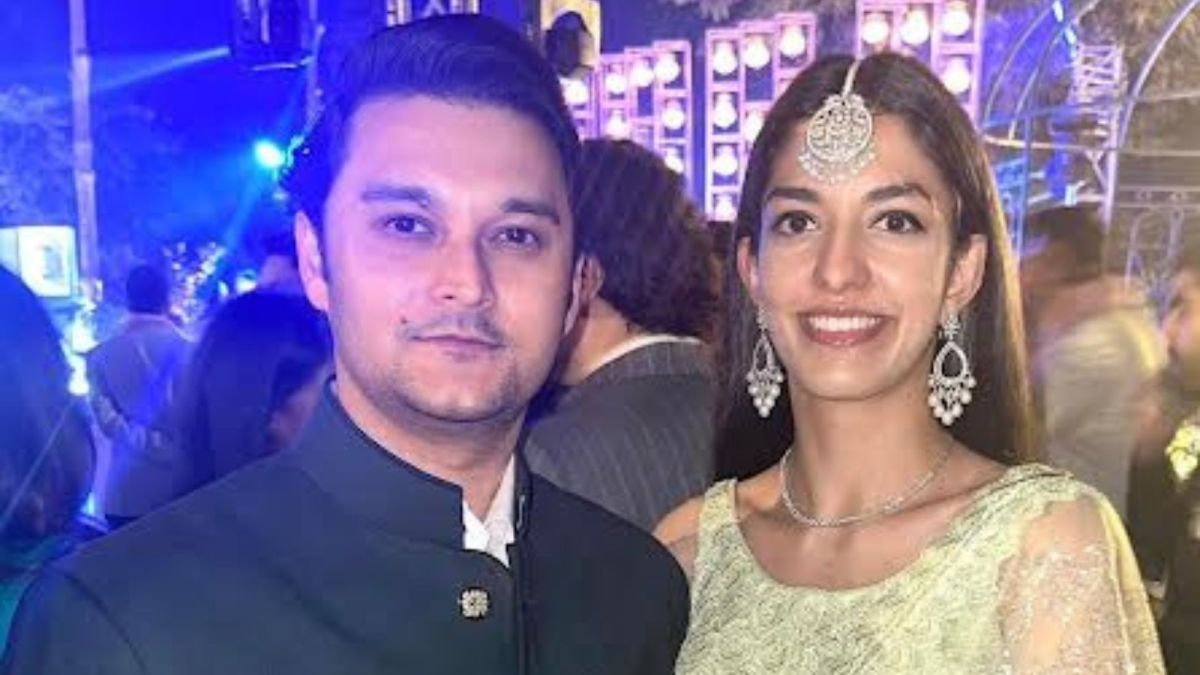
The wedding had been anticipated since the couple's engagement was publicly announced in December 2025.
Vikramaditya Singh shared the news, offering his blessings to his son and future daughter-in-law.
It immediately attracted interest because of the prominent families being joined.
When the celebrations finally arrived, they were attended by leading political personalities and members of several erstwhile royal houses.
The bride's appearance became a particular subject of attention.
Rhea wore an elaborate red bridal ensemble, richly embroidered in gold, with traditional jewellery, a head covering, a second dupatta and ceremonial ornaments.
Contemporary fashion reporting described the carefully arranged details of her bridal attire, including its jewellery and decorative embroidery.
Martand Singh appeared in richly coloured ceremonial dress, with a traditional turban and ornaments associated with the presentation of a royal bridegroom.
The effect was deliberately aristocratic.
For an evening, the atmosphere suggested the survival of an older India, with its taste for brocade, jewels, elaborate courtesy and the public display of family ancestry.
Yet this was not a gathering outside the modern political world.
Quite the reverse.
Sukhbir Singh Badal and his wife Harsimrat Kaur Badal were among the guests. So were Bikram Singh Majithia, former parliamentarian Simranjit Singh Mann and Jyotiraditya Scindia.
The spiritual leader Gurinder Singh Dhillon of Radha Soami Satsang Beas also attended.
The presence of leading BJP and Akali Dal figures inevitably attracted political attention, particularly ahead of Punjab's 2027 Assembly elections.
There has been speculation about a possible reconciliation between the BJP and the Shiromani Akali Dal.
Nevertheless, a wedding guest list is not an alliance agreement.
The presence of politicians at a family celebration cannot, by itself, establish the existence of negotiations or political commitments.
An aristocratic reception may accommodate several rival political parties with ease. It is considerably less successful as evidence that they have agreed upon a common electoral programme.
For the occasion itself, however, politics remained secondary to the family celebration.
And the arrival of Narendra Modi provided its most prominent public moment.
The Prime Minister Enters a Royal Gathering

There is a particular choreography to the arrival of a Prime Minister at a private celebration.
The conversations change. The attention of the gathering turns toward the visitor. The ordinary ceremonies of greeting acquire a public significance, and the photographers recognise an image likely to travel far beyond the room in which it was taken.
Modi arrived in comparatively simple traditional attire, wearing a light kurta and jacket, in marked contrast to the rich ceremonial clothing of the bridegroom and other members of the wedding party.
Manpreet Singh Badal greeted him. According to contemporary accounts, the Prime Minister first exchanged greetings with Dr Karan Singh, then received the respects of Martand Singh and offered his blessings to the newlyweds.
Photographs recorded the occasion with the families.
It was an encounter between two exceptionally different political biographies.
Modi represents a political tradition that rose through organisation, ideology and mass electoral mobilisation.
Dr Karan Singh was born into a dynasty whose political authority preceded India's independence and whose fortunes were irrevocably transformed by its arrival.
One man became Prime Minister through the mechanisms of a modern republic. The other had been born into a ruling household and entered constitutional public life as that household's authority receded.
Their meeting at a family wedding was entirely unremarkable in the ordinary social sense.
Historically, it was rather splendid.
The grandson of the man who signed the accession of Jammu and Kashmir to India was being married in the presence of the elected Prime Minister of that same country.
His grandfather, who had personally participated in the transition from monarchy to republican government, remained present to witness the occasion.
Such an arrangement could scarcely have been devised more neatly by a historical novelist.
Yet one must resist the temptation to turn the wedding into an official constitutional ceremony.
Modi attended as a guest, and the couple were celebrating a marriage. The significance lies in the historical associations the gathering brought into view.
What Became of the Indian Princes?

India's former princely families occupy an intriguing position in the country's public imagination.
The Constitution abolished the political order that sustained hereditary rule, and the privy purses and official recognition of princely privileges were abolished in 1971.
Yet the end of legal privilege did not mean the disappearance of the families themselves.
Some entered politics. Others established businesses, maintained charitable institutions, preserved historic properties and converted ancestral residences into heritage hotels.
Some retreated from public life. A considerable number maintained the social customs and styles of address associated with their former positions.
The survival of these titles in ordinary conversation reflects cultural usage and family tradition, not continuing constitutional authority.
That distinction should remain clear, particularly in Jammu and Kashmir, where royal history is inseparable from powerful and often conflicting public recollections of the past.
The Dogra dynasty left behind important institutions, buildings, religious endowments and administrative legacies.
Its rule is also remembered through disputes over land, taxation, representation and the relationship between the monarchy and the diverse populations it governed.
An honest account of royal history must accommodate both the grandeur and the grievances.
The Treaty of Amritsar cannot be understood solely as an achievement of dynastic ambition. The upheaval of 1947 cannot be reduced to a single heroic royal signature.
Nor can Kashmir's subsequent political history be explained without recognising the people whose lives were transformed by events occurring in palaces, military headquarters and government offices.
The fascination of this Delhi wedding lies in the fact that all these histories remain present beneath the formal elegance of a modern family celebration.
Of Crowns, Republics and the Endurance of Family
What, finally, does a royal wedding mean in a republic?
Perhaps less than admirers of monarchy might suppose, and considerably more than its critics would readily concede.
It changes no constitution. It transfers no sovereignty. It confers no political authority upon the bridegroom and demands no allegiance from the public.
But it reveals the endurance of family institutions across political revolutions.
The Dogras once ruled a Himalayan state whose territories extended across some of the most contested landscapes of Asia.
The Scindias governed Gwalior. The Patiala house occupied a prominent place among the Sikh princely families. The Badals rose to distinction through the competitive politics of independent Punjab.
Their descendants now meet as citizens of one republic, connected through marriages that would have been recognised as politically consequential in an earlier age.
That is the quiet irony of the occasion.
India abolished the royal courts, but the old families proved remarkably capable of adapting to the institutions that replaced them.
The palace survived as a residence, a museum, a hotel, a cultural inheritance and occasionally a gathering place for the elected representatives of a country that no longer acknowledges hereditary government.
The modern republic has inherited the architecture, the personalities and much of the ceremonial imagination of princely India.
It has also inherited the responsibility to understand that history honestly.
At the Delhi reception, the bride wore red, the bridegroom appeared in ceremonial splendour, distinguished relatives offered their blessings, and a Prime Minister joined the celebrations.
For Martand Singh and Rhea Badal, it was their wedding.
For their families, it was another chapter in a long and intricate genealogy.
For the historian, it was an extraordinary convergence of the past and the present.
One could look upon the photographs and admire the bridal finery, the distinguished guests and the splendour of an Indian aristocratic celebration.
One could also look more closely and see the Treaty of Amritsar, the kingdom of Gulab Singh, the troubled reign of Hari Singh, the violence of Partition, the constitutional career of Karan Singh, the political prominence of the Scindias, the history of Patiala and the democratic ascendancy of the Badals.
All of them, in their different ways, had contributed to the company gathered in Delhi.
That, perhaps, was the most remarkable picture of the evening.
This feature combines contemporary wedding reporting with historical research. Former royal titles are used as customary descriptions, not as recognition of continuing constitutional authority. Contemporary press photographs require appropriate publication rights.
Society & Heritage Desk | India Edition
Read Beyond the Headlines
© 2026 The Continental News. All rights reserved.