Jammu · Infrastructure · Mobility · Smart City
How the Superhighway Network Is Changing Smart City Jammu
Flyovers, four-lane corridors, a ring road and a new expressway connection are altering the physical grammar of Jammu. The transformation is real, expensive and unfinished, and it is being delivered not by one agency but by a complicated alliance of national highway bodies, contractors and the city's own Smart City programme.

There was a time, not so long ago, when the approach to Jammu announced itself by congestion. The old roads narrowed as they entered the city, buses and army convoys fought for road space with scooters and taxis, and every new colony seemed to place another burden upon a street system laid out for a smaller town. That Jammu is now being overlaid by concrete viaducts, four-lane carriageways and controlled-access roads is more than an engineering story. It is a change in the city's geography. Roads which once ended in bazaars are being connected to bypasses. Traffic that once had no choice but to pass through the urban core is being offered ways around it. The old City of Temples is acquiring, almost by increments, the road skeleton of a regional metropolis.
The phrase “Smart City” is easily used and often misunderstood. Jammu entered the Government of India's Smart Cities Mission in June 2017, and Jammu Smart City Limited was subsequently constituted as the special-purpose vehicle charged with implementing a programme originally costed at roughly ₹3,600 crore. Its portfolio embraced beautification, disaster management, information technology, green initiatives and, significantly, smart urban mobility. The original plan envisaged intelligent traffic management, better junctions, parking, pedestrian routes, public transport and technology-led monitoring. By 2024, officials said 117 Smart City projects had been completed, while the Integrated Command and Control Centre, intelligent traffic systems and a fleet of electric buses were changing the management of movement within the city.
But the great ribbons of concrete now altering Jammu's skyline are not, strictly speaking, all Smart City projects. They belong to a larger infrastructure revolution taking place around the city at the same time. The national highway agencies are doing what the municipal Smart City programme could never do by itself: changing the regional road geometry on which Jammu depends.
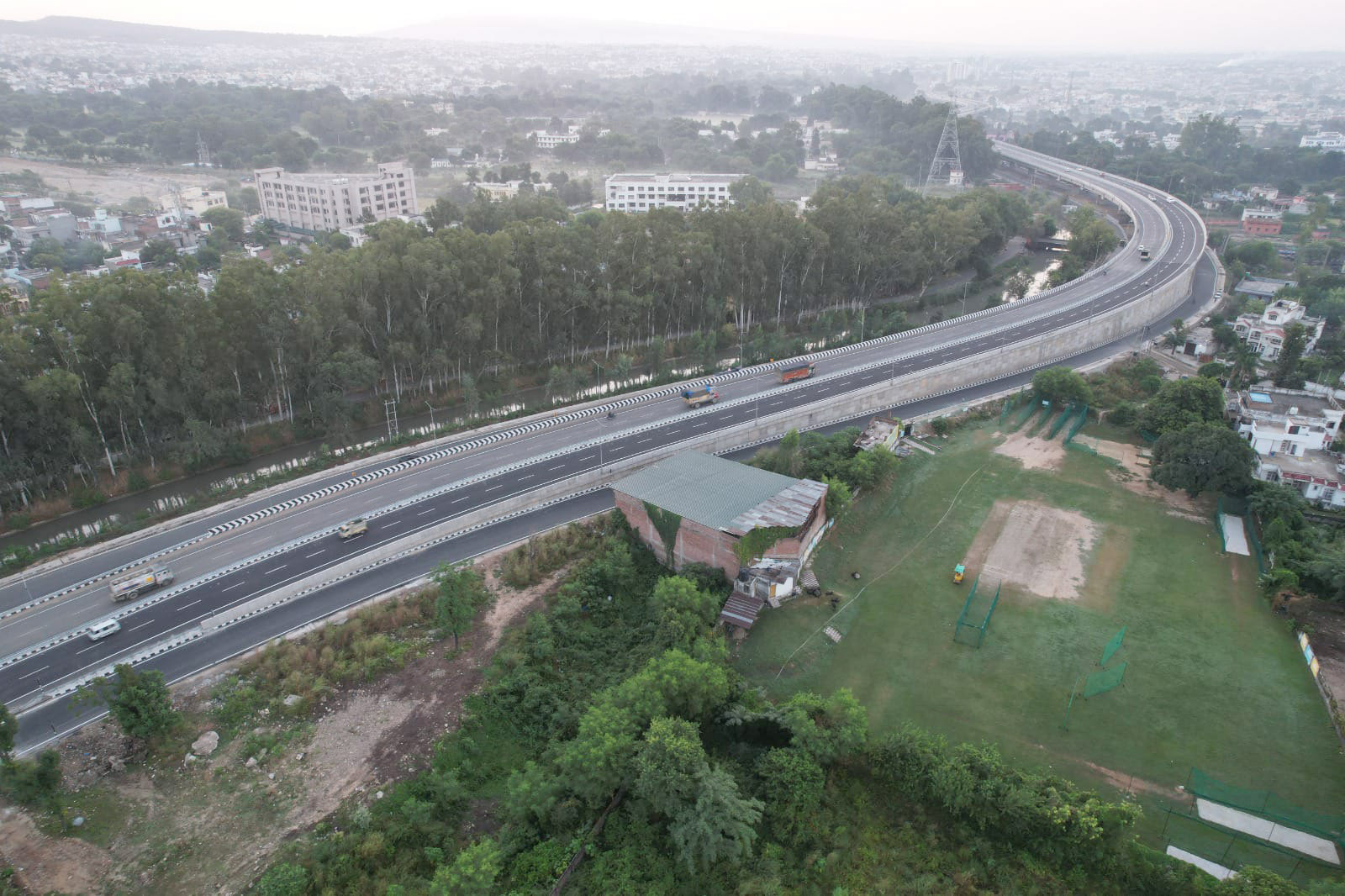
The central piece is the Jammu–Akhnoor road, NH-144A. In March 2018 the Union Ministry of Road Transport and Highways approved the upgrading of 30.097 kilometres from the Fourth Tawi Bridge towards Hanuman Chowk, Akhnoor, to four lanes with paved shoulders. The stated project cost was about ₹914.48 crore. It was not conceived merely as a wider commuter road. NH-144A is the axis towards Akhnoor and onward to Rajouri and Poonch, and therefore carries civil, commercial and strategic traffic. Widening it meant separating a regional highway function from the daily disorder of an expanding western Jammu.
The Jammu–Akhnoor corridor in figures
- Overall sanctioned stretch: about 30.097 km from Fourth Tawi Bridge towards Akhnoor.
- Package II: Canal Head to Ganesh Vihar, 5.2 km. NHIDCL records a total project cost of ₹458.06 crore. Contractor: S.P. Singla Construction. Completed 15 October 2022.
- Package III-A: Ganesh Vihar to Khati Chowk, 20.35 km. Total project cost ₹435.82 crore. Contractor: Tarmat Ltd.
- Package III-B: Khati Chowk to Hanuman Chowk, about 3.75 km, including the Chenab bridge component. Total project cost ₹198.28 crore. Contractor: V.K. Gupta & Associates.
- Package I: elevated connection from near Fourth Tawi Bridge/Bhagwati Chowk to Canal Head. NHIDCL currently lists the project as ongoing, with a total project cost of ₹245.34 crore and Maan Builders as contractor.

The most visible urban intervention has been the elevated portion. Package II produced the long flyover running from Canal Head towards Ganesh Vihar, a structure which became one of the longest elevated road sections in Jammu and Kashmir. Package I, extending the elevated system back towards the Fourth Tawi Bridge and Bhagwati Chowk, has proved slower. NHIDCL's current project page still lists it as ongoing, with physical progress of about 75 per cent and Maan Builders as the executing contractor. Its original completion date of January 2025 has passed, and the most recent official listing carried a later target in 2026. For the commuter beneath its piers, such dates matter less than the simple fact that an old bottleneck is being physically reordered.
The second great intervention lies outside the central city. The Jammu Ring Road was awarded by NHAI in December 2017 as a 58.255-kilometre stand-alone bypass from Raya Morh towards Jagti. The original EPC award was ₹1,339 crore to a joint venture of Gayatri Projects and Kyivmetrobud. The road was planned through 56 villages, nine tehsils and two districts, with major and minor bridges, flyovers and two tunnels. Its purpose was explicit: remove through-traffic from the congested city, provide a cleaner route for heavy and strategic traffic towards Akhnoor, Rajouri and Poonch, and open new development corridors around Jammu.
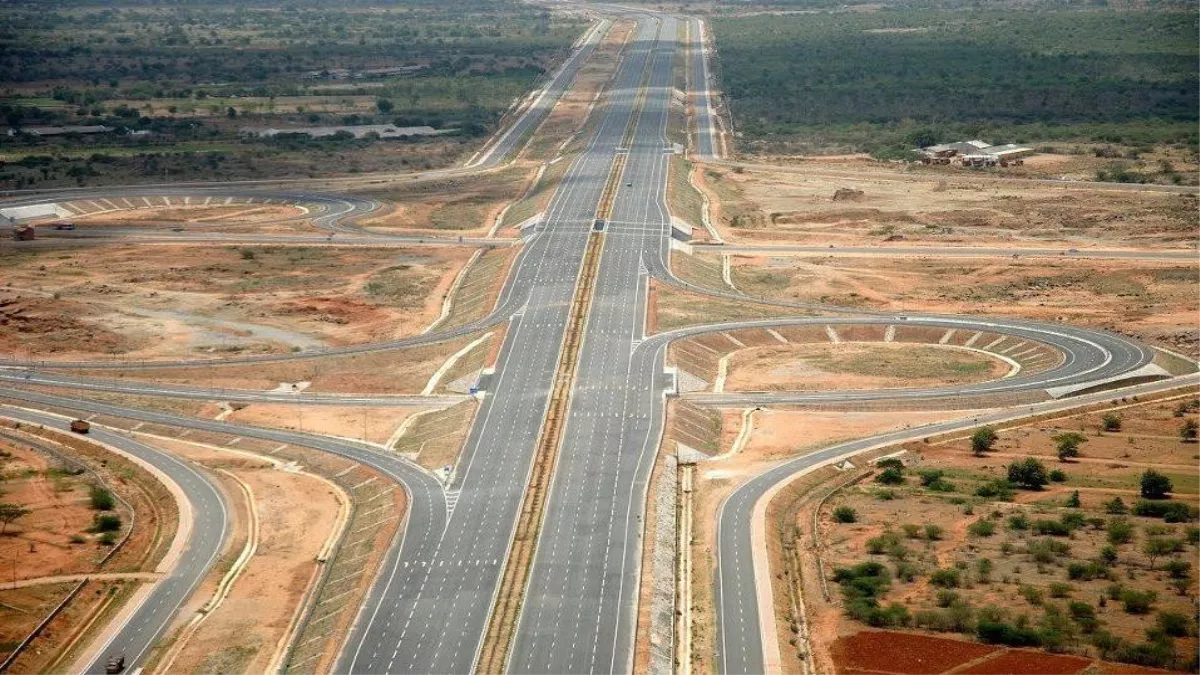
That project, too, illustrates why the word “completed” must be used carefully. NHAI records show provisional completion certification for the main ring-road package, yet work associated with the Kheri–Jagti tunnels was still under active official inspection in November 2026. On 7 November, Divisional Commissioner Vikas Kundal inspected Tunnel-1 and Tunnel-2 with NHAI Project Director Rajiv Kumar and other officers. Loose soil was reported as a difficulty affecting Tunnel-1, and the agencies were directed to accelerate the remaining work. Jammu therefore has a ring-road system that is substantially present on the ground, but still contains pieces of unfinished engineering.

The third component is larger still. The Delhi–Amritsar–Katra Expressway is designed to connect the national capital to Punjab and then to Jammu and Katra. A Rajya Sabha answer in March 2026 said the corridor would connect Jammu and reduce Delhi–Katra travel to about seven hours when fully operational. Within Jammu and Kashmir, one package runs from Gurha Baildaran to the Jammu Ring Road near Jakh, while another upgrades the Jakh–Vijaypur–Kunjwani section and provides connectivity towards Jammu Airport. These are not merely faster roads to Delhi. They change the economic meaning of Jammu by drawing the city into a controlled-access corridor stretching deep into north India.
This is where the various projects begin to act as a network rather than as isolated contracts. The expressway meets the Jammu region. The Ring Road distributes traffic around the city. NH-144A carries it west towards Akhnoor and the border districts. The upgraded NH-44 carries it north towards Udhampur, Srinagar and the Valley. Within the municipal area, Smart City's intelligent traffic management, e-buses, junction redesign and digital command systems attempt to manage the local consequences.

The result is already visible in land values, traffic patterns and the direction in which the city is stretching. Areas once considered peripheral now sit near interchanges and high-capacity roads. Warehousing, retail, housing and logistics follow accessibility. A bypass can relieve one neighbourhood and urbanise another. A flyover can save minutes for a through-driver while leaving the street below to struggle with parking, drainage, pedestrians and access to shops. The lesson from every rapidly motorising Indian city is that highways alone do not create intelligent mobility. They create capacity. Whether that capacity produces a better city depends upon what is done at street level.
This is the important distinction for Jammu. The new concrete is impressive, and in strategic terms much of it was overdue. But Smart City Jammu will not be judged by the number of piers visible from a car. It will be judged by whether the new network shortens reliable journey times, moves heavy traffic away from residential areas, makes buses more useful, protects pedestrians, prevents chaotic ribbon development around interchanges and ensures that the spaces beneath flyovers do not become the next generation of neglected urban land.

Jammu has spent decades growing faster than its roads could comfortably carry it. The present programme is an attempt to reverse that relationship. It is expensive, technically complicated and still incomplete. It involves the Ministry of Road Transport and Highways, NHIDCL, NHAI, Jammu Smart City Limited, the municipal administration, contractors including S.P. Singla Construction, Tarmat, Maan Builders, V.K. Gupta & Associates, and a succession of government departments responsible for land, utilities, traffic and local access.
But the most consequential party is the city itself. Roads are never merely lines upon a plan. They decide where houses appear, where shops survive, where industries move and how much of a citizen's day is surrendered to travel. The new highway network is therefore changing Jammu before every section is even finished. One can see it from beneath the flyovers in the photographs taken this week: the buses still stop, the shops still open, the scooters still squeeze through, but above them runs another Jammu, faster, straighter and built for distances the old city was never designed to carry.