Jammu's Drug Trade: Arrests Without the Kingpins?
Police have seized narcotics, arrested hundreds and attached suspected proceeds. The harder test is whether the supply chains, financiers and repeat offenders are being removed, and whether those struggling with dependence can obtain lasting treatment.
The arrest of a suspected drug peddler makes a simple newspaper headline. The suspect is brought before a camera, the seized substance is weighed, the police provide a statement and the public is assured that another blow has been struck against narcotics trafficking. Such arrests are important. They may interrupt a sale, remove dangerous substances from circulation and provide investigators with the first evidence of a larger enterprise. Yet they leave a question which becomes more urgent with every fresh announcement. Does the arrest diminish the trade itself, or has it merely removed one person from a network able to recruit another?
In Jammu, this is no longer a question which can be postponed to a general discussion of youth behaviour. The local police have undertaken substantial enforcement operations, and the Union Territory administration has presented anti-narcotics work as a major public priority. Families continue to fear addiction, neighbourhoods worry about petty dealing and young people require treatment as well as warnings. A serious reckoning must therefore go beyond congratulating enforcement agencies for their latest seizures. It must ask what becomes of the cases after arrest, how many investigations reach the suppliers and financial organisers, and whether the state has established a route back to ordinary life for people dependent upon drugs.

What the official figures actually establish
Figures released by Jammu Police for the calendar year 2025 and reported in January 2026 provide a useful starting point. In Jammu district, police said they registered 204 cases under the Narcotic Drugs and Psychotropic Substances Act and arrested 311 accused, including 35 women. They reported seizures of more than 15 kilograms of heroin, along with poppy straw and other substances, and said that 71 vehicles connected to trafficking had been seized. Eleven cases involved commercial quantities, leading to 38 arrests. The police also reported 48 convictions during the year, property attachments, detentions of habitual offenders and investigations extending into neighbouring districts and Punjab.
Those statistics should neither be dismissed nor exaggerated. They establish considerable police activity and reported judicial outcomes. They do not demonstrate that 48 of the 311 people arrested in 2025 were convicted in that same year, since trials often concern cases registered long before. Nor does a total of 204 new FIRs disclose how many investigations ultimately identified suppliers, how many charges survived scrutiny in court, or how many people convicted were organisers rather than low-level couriers. To calculate a meaningful conviction rate, one requires the number of cases decided during the relevant period, their outcomes and the cohorts to which they belong.
At the Union Territory level, a Narco Coordination Centre review reported in May 2026 presented a more disturbing measure of the judicial burden. Officials said that 10,956 NDPS cases were pending in courts, including 6,156 before five special NDPS courts. They reported 1,991 cases instituted in 2025 against 483 disposed of that year. Convictions were reported as 135 in 2024 and 140 in 2025 across Jammu and Kashmir. Those territory-wide figures must not be mixed indiscriminately with the Jammu district police's separate figures. Together, however, they show why counting arrests alone is an inadequate account of progress.
Jammu district, calendar 2025: 204 NDPS FIRs, 311 arrests and 48 convictions reported by police.
Jammu & Kashmir, 2025 court flow: 1,991 cases instituted and 483 disposed of, according to figures reported from the May 2026 NCORD review.
Jammu & Kashmir, May 2026 review: 10,956 NDPS cases pending. These are different geographies and reporting cohorts; none of these totals alone supplies a valid conviction percentage.
Where an arrest ends and the network begins
A local seller may know only the person who delivered a consignment. A courier may be paid for transporting a parcel without knowing the identity of its eventual recipient. The financier, supplier, organiser of communications and distributor of proceeds may occupy different places and may never handle the narcotic substance personally. These arrangements are not peculiar to Jammu. They are a recurring feature of illicit trade, which is precisely why police work that stops at possession leaves the larger business intact. The difficult part of an investigation is often the reconstruction of communications, money, transport and repeated contacts across apparently separate cases.
There is evidence that Jammu Police have sought to pursue this larger task. Their 2025 account included 12 supply-chain investigations and 36 arrests across Jammu, Punjab, Kathua, Udhampur and Rajouri. The police also reported attaching property identified as proceeds of narcotics offences. In April 2026, they announced the arrest of Gulzar Ahmad, known as Lau Gujjar, whom senior officers described as a significant figure in a cross-border supply network. Police said he was wanted in numerous cases and alleged that some consignments may have been sourced through drone deliveries linked to Pakistan. These remain police claims concerning an accused person; the outcome of criminal proceedings must determine guilt.
That example complicates any convenient declaration that the authorities have arrested nobody important. The sounder criticism is that occasional major arrests and many smaller seizures do not yet provide a public measure of how far the underlying enterprise has been dismantled. What happened to the linked bank accounts? Which transactions were traced to other organisers? How many alleged associates were charged, how many prosecutions have concluded, and how much of the confiscation action has survived legal challenge? The public has a legitimate interest in the answers, subject to the protection of ongoing investigations and the rights of accused persons.
The financial trail and the law
Drug markets survive because money moves. A kilogram seized has a value only to the extent that a network can turn it into income. The practical questions are consequently financial as well as criminal. Have investigators examined legitimate businesses suspected of disguising proceeds? Are the same bank accounts, vehicles, mobile connections and intermediaries appearing in unrelated prosecutions? Are police in Jammu, Punjab and other jurisdictions sharing intelligence promptly enough to recognise common organisers? No public article can reasonably demand the release of sensitive operational methods, but annual totals of attached assets, charges against organisers and final judicial outcomes would permit meaningful scrutiny.
Property attachment is a significant instrument, although it is not proof that every targeted person is guilty. The seizure or demolition of property is also not interchangeable with a criminal conviction. Each action has its own statutory basis and safeguards, and the state must be capable of defending its decisions before a court. Public confidence is not strengthened by a display of force which later collapses for want of evidence. It is strengthened when substantial investigations produce admissible proof, fair trials and judgments that can withstand appeal.
In June 2026, officials described a territory-wide 76-day campaign involving 1,527 FIRs and 1,731 arrests, together with narcotics seizures, detention orders and action against properties and chemists. Such numbers convey the scale of a mobilisation. They remain output measures. The lasting result would be a demonstrable reduction in the availability of drugs, an increase in successful prosecutions against principal organisers and measurable improvements in treatment and recovery. Without those comparisons, an energetic campaign can produce a succession of impressive announcements while the demand and supply that sustain the trade continue.
The court backlog cannot be a footnote
The backlog of NDPS proceedings is of particular consequence because justice delayed damages both public safety and individual rights. A case involving an alleged supplier may remain unresolved while witnesses become difficult to locate and evidence requires preservation. An accused person who has been wrongly implicated may suffer years of uncertainty. A guilty person may ultimately be convicted after such a lapse of time that the deterrent force of the law is diminished. Special courts must have adequate judicial officers, prosecutors, forensic facilities and support staff. The work of a police officer who makes a lawful arrest is incomplete if the prosecution cannot bring the evidence before a functioning court in reasonable time.
There is another statistical difficulty. A conviction figure may refer to people, cases, charges or decisions, depending upon the reporting system. Policymakers should publish common definitions and distinguish prosecutions under way from completed judicial outcomes. TCN would like to see the Jammu district figures for cases filed, charge sheets submitted, trials concluded, acquittals, convictions, appeals and average disposal time, accompanied by a separate classification of commercial-quantity cases and alleged organised networks. These are questions suitable for a Right to Information request or a formal written response from the police and prosecution authorities.
Beyond punishment: the treatment that families need
There is a human danger in allowing the language of trafficking to absorb every person affected by drugs. A dependent young man is not automatically the financier of a narcotics syndicate. Some individuals may commit offences to sustain their dependence, but a health condition and an organised criminal enterprise are not the same thing. A responsible public policy maintains that distinction. It requires police action against supply and exploitation, medical treatment for substance dependence, professional counselling and the support required to return to education, employment and family life.
The Police Drug De-addiction and Rehabilitation Centre at Channi, Jammu, illustrates why the treatment figures deserve a place beside the enforcement figures. The police's account of 2025 recorded 1,667 outpatient contacts and 311 admitted patients there. Those figures indicate service use but do not disclose the number of unique patients, treatment completion, relapse rates or outcomes after discharge. A person who arrives for help once is a different measure from someone who completes treatment and maintains recovery over a year. Both must be counted in a way that preserves patient privacy.

Government programmes provide a framework for extending such services. The Union Ministry of Social Justice and Empowerment supports rehabilitation and district-level treatment arrangements under the National Action Plan for Drug Demand Reduction and the Nasha Mukt Bharat Abhiyaan. In August 2026 the Union government described further treatment and awareness initiatives in Jammu and Kashmir. Yet families need practical answers close to home. How long must a patient wait for admission? Is detoxification supervised by qualified clinicians? Are there affordable follow-up services in each district? What support exists for women, adolescents and families who fear social exposure? Can a recovered patient obtain help returning to work?
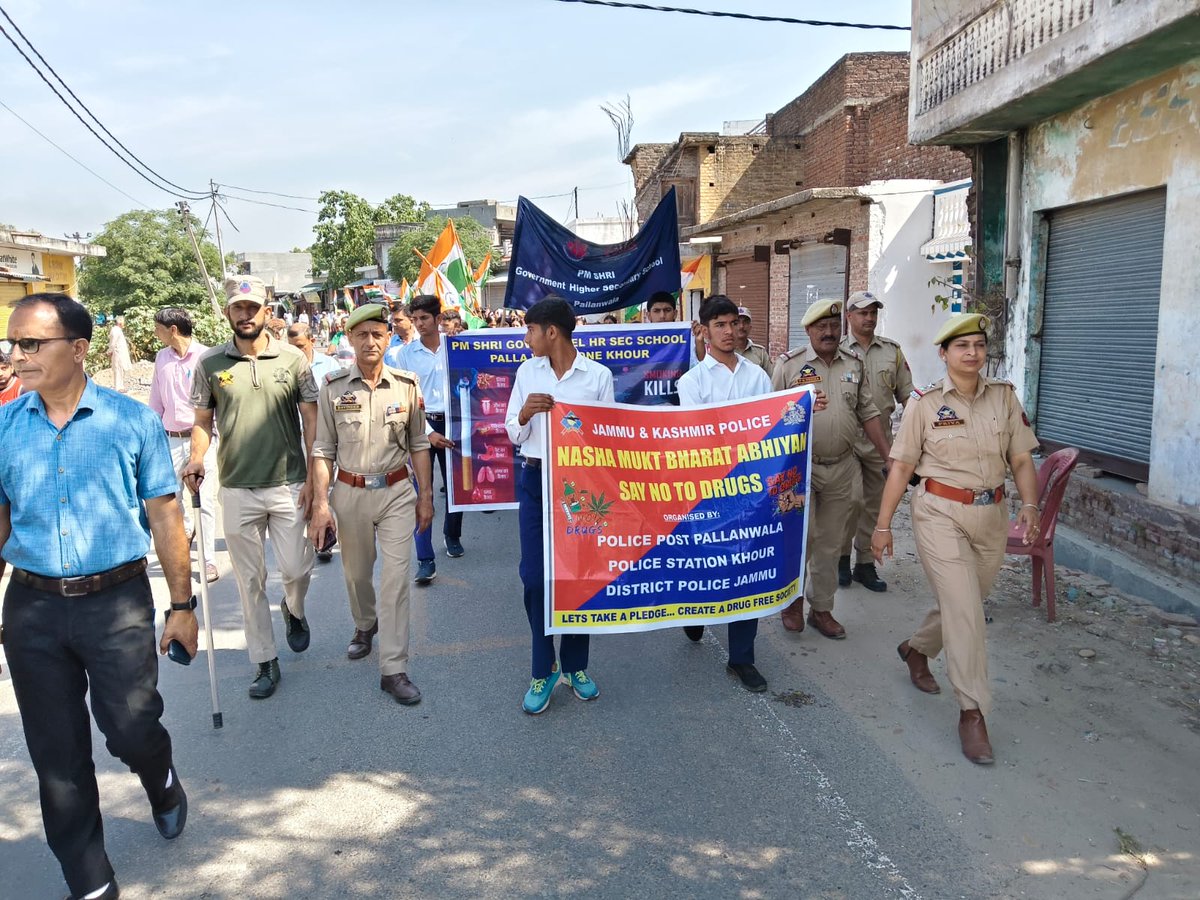
One must resist the temptation to describe awareness rallies as if they were treatments. Public meetings and student marches can help reduce stigma and encourage reporting, but a pledge cannot replace a clinical appointment. The question for administrators is whether the considerable energy devoted to campaigning has been matched by sustained expenditure on trained clinicians, follow-up counselling and dependable records of recovery. The answer ought to be measurable and public, without exposing the identities of patients who seek help.
The questions Jammu deserves answered
Jammu's drug problem cannot be solved by a newspaper headline, nor can a columnist responsibly identify alleged kingpins without evidence and due process. Yet a newspaper can insist that the measures of success be worthy of the gravity of the issue. Police should publish comparable annual figures on major network investigations, financial trails pursued and court outcomes. Prosecutors should explain the obstacles created by delays, forensic capacity and witness attendance. Health authorities should report treatment accessibility and follow-up outcomes in anonymised form. Schools and community organisations should have clear channels through which families can seek confidential assistance without fear of humiliation.
It would be unjust to ignore police officers who take personal risks confronting suspected traffickers. It would be equally unwise to allow praise for arrests to terminate the public discussion. The people of Jammu are entitled to know whether organisers are being convicted, whether money is being recovered lawfully, whether the supply of drugs is demonstrably shrinking and whether young people who have become dependent are receiving effective care. The point of a serious campaign is to make the next generation of arrests less necessary, not to celebrate an indefinitely rising count.
There is, finally, a difference between a police operation and a public victory. An operation can be recorded at the moment a suspect is detained. Victory requires patience, evidence, functioning courts and the recovery of lives which might otherwise be lost. Until those measures are brought into the same public account, Jammu may continue to read of arrests without knowing how much of the trade has truly been broken. That uncertainty, rather than any presumption of failure, is the question which authorities should now answer.