Cricket · Portrait · Sachin Tendulkar · 37 Years Since His Debut
The Hidden Sachin Tendulkar
The world knows the hundred hundreds, the 34,357 runs and the boy who became the God of Cricket. It knows less about the child behind the bat, the blood at Sialkot, the thirteen coins, the brother who saw destiny before India did, the poet-father who taught humility, and the private rituals that kept a public deity human.
The bat is absurdly small now. In the hands of the fifty-three-year-old man it seems almost a toy, a piece of wood rescued from a cupboard where childhood has been waiting quietly for the world to grow old. Yet on 15 November 2026, Sachin Ramesh Tendulkar held it again and the years collapsed. Beside the new photograph was the old one, a little boy with unruly hair, bare feet and a bat nearly as tall as his ambition. “Pehle bat ki baat hai, 49 saal baad bhi mere saath hai,” he wrote. The first bat, still with me after forty-nine years. In an age that throws everything away, Tendulkar had kept the beginning. Perhaps that is the truest clue to the man the world never completely knew. The career was built on accumulation, but the character was built on preservation.

He was born in Bombay on 24 April 1973, the youngest child of Ramesh Tendulkar, a Marathi poet and professor, and Rajni, who worked for the Life Insurance Corporation. His father named him after the composer Sachin Dev Burman. The boy later described with religious vocabulary was, by his own account, far from saintly. At Sahitya Sahawas in Bandra East he played pranks, loved tennis, idolised John McEnroe and possessed the sort of energy that frightens adults until somebody finds the proper use for it.
That somebody was Ajit, his elder brother. Ajit saw what others had not yet seen and took him to Ramakant Achrekar at Shivaji Park. The first trial did not go well. The boy was nervous under the coach’s eye. Ajit asked Achrekar to watch from a distance, as though he were not there. The change was immediate. The strokes appeared. So did the future. Thereafter the geography of Tendulkar’s childhood became the geography of Bombay cricket: buses, maidans, school matches, nets, sweat, dusty whites and the evening journey home with a kit bag far too large for the child carrying it.

Achrekar’s methods became folklore because they were simple. He would place a one-rupee coin on the stumps. If a bowler dismissed Sachin, the bowler kept it; if the boy survived, the coin was his. Tendulkar still has thirteen. Before the contracts and endorsements came thirteen small coins earned by refusing to get out. He trained from morning to evening, moving from nets to matches and back again. The genius was real, but it was worked upon until excellence became habit.
At fourteen, he and Vinod Kambli put together an unbeaten 664-run partnership for Shardashram Vidyamandir in the Harris Shield. At fifteen, Tendulkar made a century on his Ranji Trophy debut for Bombay. He would also score centuries on debut in the Duleep and Irani trophies, an almost indecent way of announcing himself at each new gate. By sixteen, the selectors had sent him to Pakistan, where India’s most difficult cricketing neighbour possessed Wasim Akram, Imran Khan and a young Waqar Younis whose speed was not yet burdened by reputation because he, too, was just beginning.

The mythology is often misremembered. Tendulkar did not bleed from the first international ball he faced. He made his Test debut at Karachi on 15 November 1989 and scored 15 before Waqar bowled him. The blood came later in the series at Sialkot. India were in trouble at 38 for four when a Waqar bouncer struck the sixteen-year-old on the nose. Blood appeared. Navjot Singh Sidhu, at the other end, feared the boy might have to go to hospital. Tendulkar refused to leave. The line that survived was brutally plain: “Main khelega.” I will play. He continued, made 57 and helped India save the Test and the series. Years later he said the blow made him tougher. It was not his first encounter with pain; Achrekar’s uneven practice pitches had already taught him that the ball sometimes collected a price.
The first Test hundred came at Old Trafford in 1990 when he was seventeen, an unbeaten 119 that saved India. Australia followed: 148 not out in Sydney and 114 at Perth in 1992, on a surface hostile even to seasoned batsmen. From there the career stopped being a promising story and became an occupation of world cricket. He opened in one-day cricket in 1994, found a freer version of himself, and eventually finished with forty-nine ODI hundreds.
There were afternoons when he seemed less a batsman than a weather system. Sharjah in April 1998 remains the great example. A sandstorm swept across the ground during India’s chase against Australia. When play resumed, Tendulkar produced 143, carrying India into the final despite defeat, then made 134 against the same attack two days later on his twenty-fifth birthday to win the trophy. The two innings became known as the Desert Storm, and for Indian television audiences of that generation the memory remains almost physical: Shane Warne circling, Tendulkar advancing, the bat coming down, the ball disappearing into a hot Arabian night.

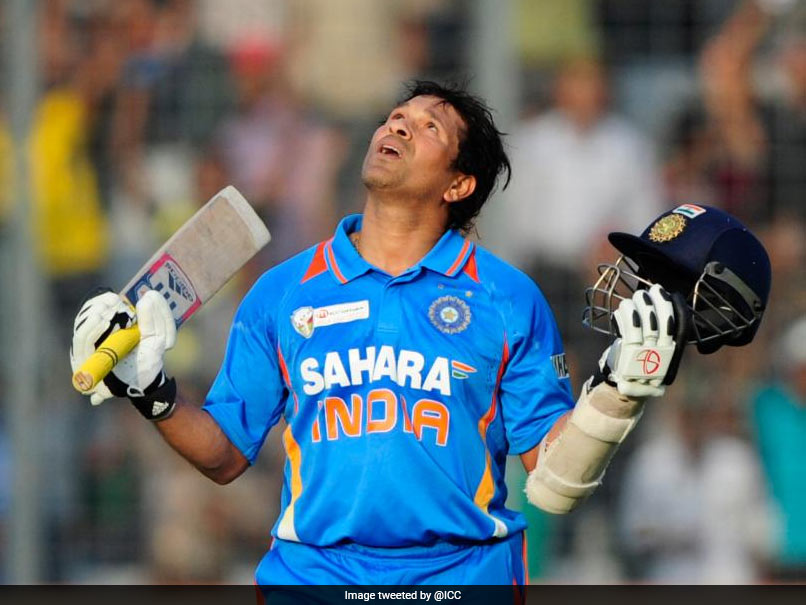
His father’s influence ran deeper. Ramesh Tendulkar had told him that success must never breed arrogance, and that he would rather hear people call his son a good human being than merely a great cricketer. When Ramesh died during the 1999 World Cup, Tendulkar flew home from England for the funeral, then returned to the tournament and made 140 not out against Kenya. He looked upward after reaching his hundred. It was one of those rare occasions when the private man became visible inside the public cricketer.
The Record That Became Myth
| Achievement | Record |
|---|---|
| International runs | 34,357, the most in international cricket |
| International centuries | 100 — 51 in Tests and 49 in ODIs |
| Test cricket | 200 matches, 15,921 runs |
| One-Day Internationals | 463 matches, 18,426 runs |
| Men’s ODI double hundred | First batter to score one, 200* against South Africa at Gwalior in 2010 |
| World Cups | 2,278 runs, the most in men’s World Cup history |
| Career span | 1989–2013, 24 years of international cricket |
By the time he reached his hundredth international century, the number had become oppressive. Ninety-nine sounded incomplete and every innings became a referendum. He finally made the hundredth against Bangladesh in Dhaka on 16 March 2012, scoring 114. No other cricketer has matched it. A century is rare enough; to make one hundred of them across formats, attacks, pitches, injuries and more than two decades is not merely arithmetic. It is endurance turned into record.
The great missing prize had been the World Cup. He had played in 1992, 1996, 1999, 2003 and 2007 without winning it. In 2011, at thirty-seven, he was India’s leading run-scorer in the tournament. When Mahendra Singh Dhoni struck the winning six against Sri Lanka at the Wankhede, teammates lifted Tendulkar onto their shoulders and carried him around the ground. Virat Kohli, then twenty-two, offered the line that history had prepared for him: Tendulkar had carried the burden of the nation for twenty-one years; it was time for the team to carry him.

He retired from Test cricket in November 2013 after his two-hundredth match, again at Wankhede. His final innings was 74. The farewell speech stripped away the godhood more effectively than any statistic could reinforce it. He thanked his family, coaches, teammates, doctors, friends and supporters. He bent to touch the pitch. Then he walked away from the place where millions had projected onto him their hopes, frustrations, patriotism and nostalgia.
And now there is the little bat. Forty-nine years after a child first held it, the man has not thrown it away. That may be the hidden Sachin Tendulkar in one image. Not the god, because gods require no coaches, no brothers, no fathers, no surgery and no courage. Tendulkar required all of them. The mythology grew because the human being underneath it kept returning to the work.
The world remembers the straight drive, the hundred hundreds, the helmet raised to the sky and the chant rolling around stadiums: Sachin, Sachin. But perhaps the better story begins before all of that, with a child in Bombay gripping a small bat, and ends, if it has ended at all, with an older man holding the same piece of wood and smiling. Between those photographs lies an epic measured in runs, blood, discipline, grief, reinvention and time. Cricket called him its God. The bat remembers when he was only a boy.
References
International Cricket Council Hall of Fame: Tendulkar career records and milestones.
Contemporary reports and interviews on his 1989 Pakistan debut and Sialkot injury, including Tendulkar’s own recollection of continuing after being struck by Waqar Younis.
Reuters cricket archive: Tendulkar’s 13 Achrekar coins and career trivia.
India Today and Indian Express interviews and autobiography coverage: family background, Ajit Tendulkar, Ramesh Tendulkar, Ramakant Achrekar and early life.
Current reports dated 15 November 2026 on Tendulkar’s post showing his first bat after 49 years.