THE CONTINENTAL NEWS™
WELL DONE,
SKIPPER.
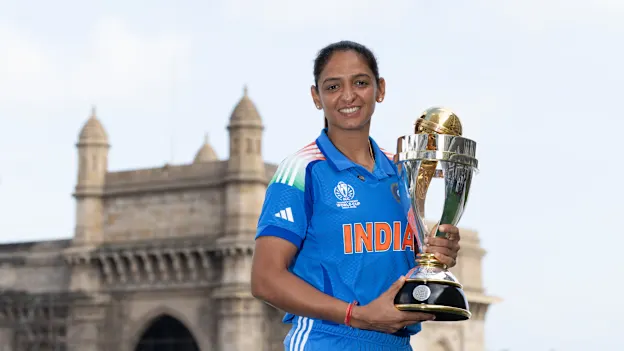
There are captains who win matches. There are captains who collect trophies. And then, every few decades, there is a captain who changes what an entire country believes its team is capable of becoming. Harmanpreet Kaur belongs to that last company. She leaves the Indian captaincy with medals, records and a World Cup, but none of those is quite the whole story. The larger achievement is this: she made Indian women's cricket believe that the biggest stage in the world was not somewhere it had been invited to visit. It was somewhere it could own.
That is why the comparison with Kapil Dev carries meaning. Kapil's India did not simply win the 1983 World Cup. It destroyed a mental barrier. Until then, the great powers of international cricket appeared to belong to another order. After Lord's, India no longer asked whether it could stand among them.
Women's cricket waited longer for its own moment.
In 2025, Harmanpreet Kaur gave it one.

Her defining act arrived years before the trophy. At Derby in 2017, India faced Australia in a World Cup semi-final. Australia were the champions, the standard, the team everyone measured themselves against. Harmanpreet walked in with India under pressure and produced an innings that still feels slightly unreal.
She made 171 not out from 115 balls.
Twenty fours. Seven sixes. No fear.
It was not a careful innings constructed around survival. It was an attack. She drove, swept, charged and lifted Australia's bowlers as though the occasion existed for her benefit. ICC later described the innings as one of the defining performances of the tournament. India won by 36 runs and went to the final. :chatgpt-content-reference{index="1"}
India did not win that final. England beat them at Lord's. But something had already happened that no result could reverse. Millions of people in India had watched Harmanpreet dismantle Australia. Women's cricket had produced not merely a good performance but a national sporting event.
This mattered. For years, women cricketers in India had been required to do extraordinary things to earn ordinary attention. Harmanpreet's 171 made indifference harder.
She was already doing something equally important beyond the World Cup. In 2016, Harmanpreet became the first Indian woman to sign for an overseas T20 league when Sydney Thunder recruited her for the Women's Big Bash League.
That move carried a message larger than a contract. An Indian woman cricketer was not being included for symbolism. She was being recruited because a foreign franchise believed she could win cricket matches.

That distinction is important. Sporting equality does not arrive when somebody is permitted to participate. It arrives when somebody becomes valuable enough to be pursued.
Harmanpreet had become valuable everywhere.
She became India's full-time T20I captain in 2016 and took charge across the longer formats after Mithali Raj's international retirement in 2022. The job brought glory, but it also brought the kind of scrutiny reserved in India for people who carry a cricket team on their shoulders.
India lost finals. They lost semi-finals. They were criticised for selection, tactics, temperament and the inability to convert promise into the biggest prize. Harmanpreet absorbed much of it.
There were moments when the question followed her everywhere.
Could this generation actually win one?
The answer eventually arrived at home.

The 2025 World Cup did not become India's because the tournament was easy. Quite the opposite. Australia again stood in the path. In the semi-final, they made 338.
India were 59 for two.
Harmanpreet walked out and joined Jemimah Rodrigues.
Together they added 167. Harmanpreet made 89. Rodrigues finished unbeaten on 127. India reached 341 for five and completed what was then the highest successful chase in women's ODI history.
Three days later came South Africa in the final.
India won by 52 runs.
And history supplied one last piece of theatre. When Nadine de Klerk sent the ball into the air, it was Harmanpreet who took the catch that ended the match.
The captain who had lived with the disappointment of the 2017 final was holding the ball when India's wait ended.
There are sporting images that are greater than the second in which they occurred.
That catch is one of them.
The scorebook says Harmanpreet captained India in 211 internationals across formats. It says she led India in 155 T20 internationals, more than any captain before her had managed in the format. It records two Asian Games gold medals and the 2025 World Cup. ICC confirms those figures and that she became the first man or woman to captain a country more than 150 times in T20 internationals. :chatgpt-content-reference{index="2"}
The scorebook cannot record everything else.
It cannot properly measure what happened to the ambition of a young girl watching television in Punjab, Mumbai, Ranchi, Jaipur or a town whose cricket ground does not yet have a women's dressing room.
It cannot calculate the cultural distance between women cricketers once playing before modest crowds and today's players walking into packed stadiums as nationally recognised athletes.
It cannot place a number beside the Women's Premier League, increased broadcasting, sponsorship, crowds and the sense that women representing India are no longer appearing on cricket's margins.
Harmanpreet did not create that revolution alone.
Mithali Raj and Jhulan Goswami carried the game through an earlier and harder age. Smriti Mandhana became one of the finest batters in the world. Deepti Sharma, Jemimah Rodrigues and a new generation pushed the team further. Administrators, coaches, broadcasters and supporters all changed the ecosystem around them.
But sporting revolutions eventually acquire a face.
Harmanpreet became one of the faces of this one.

At 37, Harmanpreet has now stepped down from the captaincy across all formats. She is not retiring. Her own message was clear: captaincy ends, the journey continues. Smriti Mandhana will now take over the side. :chatgpt-content-reference{index="3"}
That is an important distinction.
India is not saying goodbye to Harmanpreet Kaur.
It is saying goodbye to Harmanpreet Kaur the captain.
The woman handing over the job leaves behind a team unlike the one she inherited. The next captain will lead players who expect full houses. They expect television coverage. They expect professional contracts. They expect to compete with Australia and England. They expect to win.
That change in expectation may prove more enduring than any single victory.
Kapil Dev's 1983 side taught India that the world's strongest teams could be beaten.
Harmanpreet's generation taught millions of Indian girls that this lesson belonged to them too.
So the armband moves on.
The record books remain.
The World Cup remains.
And the belief remains.
You left the next captain a country that already believes it can win.
From the unbeaten 171 against Australia at Derby in 2017 to the World Cup triumph of 2025, Harmanpreet Kaur's captaincy years helped take Indian women's cricket from the fight for recognition to the expectation of victory.